
Does a Solar CCTV Camera Work on Cloudy Days and Monsoon?
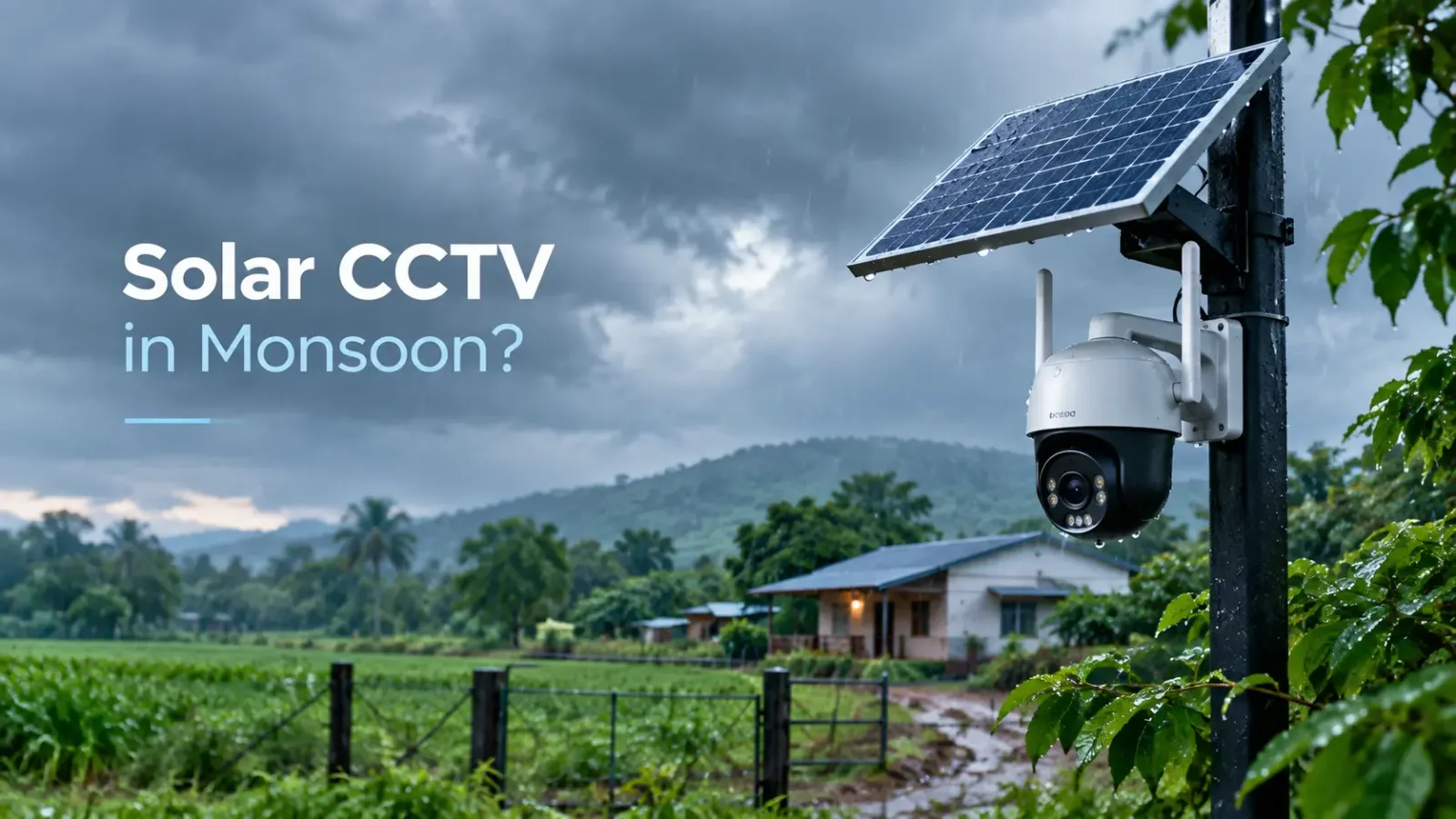
Online, the battery backup of a solar CCTV camera ranges from 36 hours to 300 days. Both claims can be honest, because the two cameras do very different jobs. We sell and install solar cameras for farms, plots and homes in Kalaburagi. Customers often ask us what happens on cloudy days and in the monsoon.
This guide explains how a solar camera behaves on grey days and in heavy rain. You will learn to read a battery claim and spot a camera that will go dark in July. Most guides skip the arithmetic, so we show it step by step. Every number comes from a named source, and we mark the arithmetic that is ours. Read on, and you will have a simple way to judge any solar camera before you pay for it.
The Short Answer, Before the Details
Yes, but there are some conditions. The solar CCTV will work during cloudy days and the monsoon as long as the camera keeps recording clips of movement and sending alerts to your phone. This is possible if:
- Battery size is the first thing to check. The battery is the tank that carries the camera when the sky gives little power. A small tank empties within a day or two of grey weather.
- Next comes the way the camera records. A camera that wakes for a few seconds and then sleeps uses very little power. One that records all day drains the same battery in about a day.
- Last comes the solar panel itself. Dust, bird droppings and the shadow of a tree all cut the power that reaches the battery. Miss any one of these three, and the camera will go dark after a few grey days.
| Setup | Cloudy days with no useful charging |
|---|---|
| Motion-recording camera, about 66 Wh battery (18,000 mAh) | Roughly 4 to 7 days (our arithmetic) |
| Same camera recording nonstop | About half a day to a day (our arithmetic) |
| Hikvision solar 4G camera, 40 W panel, 20 Ah battery | Up to 5 days, as quoted in a reseller listing |
These are rough figures from published numbers and our own arithmetic. Your camera’s spec sheet and recording settings decide the real result.
In short, one cloudy day is rarely the problem. A long run of grey days with a small battery and a nonstop camera is the real problem.
Does a Solar Panel Still Charge When the Sky Is Grey?
Yes, but much less. Imagine your solar panel is a tap and your battery is a tank. On a bright day the tank will fill up quickly. However, if it is cloudy you get a trickle of charge and if it is very cloudy during the monsoon you get even less.
The solar panel will still work in low light, so a cloudy afternoon still adds some charge to the battery. If it is very cloudy for several days then you will get very little power. During the monsoon months (June-Sept) the sky can be very grey for several days. A larger battery keeps your camera going through these weeks.
The guides for sizing your solar panels in India are based around 5 hours of good sunlight per day. This means that a 20W panel will give you roughly 100Wh of power (before any losses). One guide suggests using a 20-40W panel for a motion activated camera. The panel is larger than you would need for one day so that you still get power into the battery on grey days.
Think of the system as three parts. The solar panel gathers the power, the battery stores it and the camera uses it. Whilst there is sun the panel will power your camera and charge your battery. Once the sun goes down your battery will have to power everything.
Something that catches a lot of people out is that although solar will solve your power issue you still need to think about your signal. You will still need a 4G sim card or a wifi router nearby. Make sure to plan this out as you won’t be able to get the video to your phone.
Why Do Battery Claims Range From 36 Hours to 300 Days?
The numbers look like a contradiction, so here are the actual claims side by side.
| Camera | Claimed backup or battery life | Where the claim appears |
|---|---|---|
| Secureye solar 4G camera | 24 to 48 hours without sunlight | Secureye blog |
| Godrej ACE Pro Green | 36 hours | SmartHouseGears review |
| Hikvision solar 4G camera | Up to 5 days on cloudy days | Reseller product listing |
| Trueview 4G Solar 4MP | 70 to 80 days | SmartHouseGears review |
| TP-Link Tapo C425 | Up to 300 days | SmartHouseGears review |
None of these is necessarily wrong, but each one assumes a different way of recording. Compare a parked car with one stuck in traffic, and the same fuel tank gives very different range. A camera battery behaves the same way. Big numbers fit a camera that sleeps almost all day and wakes only for short motion clips. Cameras that stay awake for longer produce the small numbers. Makers rarely say which one they measured.
You can do some basic math to verify any claims. For example, the Trueview has an 18,000mAh battery. Most lithium cells are 3.7v so if you multiply the 18,000mAh by 3.7 you get 66Wh. You can look up your own spec sheet to find out the voltage. One sizing guide shows that a PIR camera uses around 10-15Wh per day. This means that you will be able to go for around 4-7 days without needing to charge. If it is constantly recording then it will be using 60-120Wh per day meaning you would only be able to get around half a day to one day out of the battery.
Now look at the 70 to 80 day claim again. For it to hold, the camera must use less than 1 Wh a day. That is only possible if it sleeps almost all the time. This is our arithmetic, not a lab test.
Be careful when comparing mAh with Ah figures, because the voltage may differ between batteries. Watt-hours are the fair way to compare two batteries. So before you buy, ask the seller three things.
How Many Cloudy Days Can Your Camera Really Handle?
What is the battery size in watt-hours?
How many days does the claim cover, and in what recording mode?
Does the claim include any solar charging, or battery only?
Let’s break it into 3 steps:
- Calculate the battery size (if you have it in mAh then multiply by voltage then divide by 1000).
- Work out approximately how many watt-hours your camera uses per day. Motion clips use a lot less power so will depend on your settings.
- Divide the energy stored by the energy used per day. This will tell you how many days you’ll have coverage for with no charging.
Below are some examples using 3 popular battery sizes. We’ve assumed a voltage of 3.7v. Motion will use between 10-15Wh per day and continuous will use between 60-120Wh.
| Battery | Stored energy | Motion recording | Nonstop recording |
|---|---|---|---|
| 10,000 mAh | about 37 Wh | 2.5 to 3.7 days | Under 1 day |
| 18,000 mAh | about 66 Wh | 4 to 7 days | About half a day to a day |
| 20,000 mAh | about 74 Wh | 5 to 7 days | About half a day to just over a day |
Try it out on your wall/pole. After 3 cloudy days use the app to check how much battery it has. If it is depleting quicker than your calculation then it will be due to a small panel, dirty panel or shading.
Let’s use an example. A camera on a farm gate has a 74Wh battery and uses 12Wh per day to record motion. It will last around 6 days if there is no charging at all. In reality there will be some charging on cloudy days so it will usually last longer. Round your number down due to battery degradation and heat reducing the life of the battery. If your answer is less than the longest grey days in your area then you should get a larger battery or set it to only record motion.
The most important thing to think about is the recording style. If the camera is set to record motion it will only turn on for a few seconds, record a clip and then turn off. If it is set to record constantly then it will drain the battery quickly. Solar is great for recording motion, like a farm gate which may only open 12 times per day.
What the Kalaburagi Monsoon Does to a Solar Camera
Dust and bird mess can cause issues. The dust means less power is generated due to the dirt on the panel glass. 20-30% power loss is claimed on one review site but there is no evidence to back it up. Either way it is good to wipe it clean with a dry cloth. After heavy rain it is also a good idea to wipe clean as water stains form a layer.
Battery life during the summer can be an issue in Kalaburagi and the open fields mean temperatures can be extremely high and lithium cells degrade quicker than what is mentioned on a datasheet. Be prepared to change the battery every few years.
Angle the panel correctly. Make sure it is facing South and angled to around your latitude. Kalaburagi is around 17 degrees North, so angle the panel between 17 and 20 degrees. Some guides suggest 30-45 degrees which works well for cities much further North.
Panel size should be based off of the worst month. A sizing guide suggests double or triple the amount you need per day. The battery should have 2 or 3 extra days of coverage.
Make sure the panel is in full sunlight all day. If half the day is shaded by a tree, water tank or wall then it will not work well. Check your phone has a signal (4G). If it doesn’t then the camera will have power but won’t transmit any video.
Before the rain hits make sure there are no gaps in the seals of the camera or cable entries. There is a real risk when cleaning and fitting the panel. If it is wet then use a sturdy ladder and never climb up a wet wall. Anything high up should be fitted by a trained installer.
Where Solar Cameras Fail in the Rain, and How to Avoid It
Most issues can be solved by addressing just a few issues.
- The solar panel isn’t in full sun. Partial shading will reduce the charge so much that you need to put it in full sunlight. If this isn’t possible then try putting it on its own pole facing South.
- The solar panel isn’t big enough. A small panel won’t charge your battery on grey days. Make sure you have a solar panel bigger than you need every day as explained above.
- The camera is constantly recording. This will drain your tank in a day. Change to motion recording.
- You don’t have good 4G signal. If you don’t have good signal then you won’t be able to upload your videos even if your battery is fully charged. Check which network your sim card is on and use the best signal.
- Your solar panel is easily accessible. A bright solar panel on a lone pole will draw attention. Put the panel high up with anti tamper fittings.
By solving these 5 issues you’ll eliminate the most common reasons why your camera would be dark.
If you have more than 10 grey days you can use a USB power bank to recharge some cameras and check your camera manual to see if it can be charged via USB.
Don’t fall into the trap of choosing a cheap camera. A cheap camera with a small battery will run out quickly in a shaded area or poor signal area. Check the shading, signal and battery size of the camera first and the price will become an easy choice.
Which Solar Camera Suits a Farm, a Plot or a Home Here?
Solar earns its place where mains power is far away. A distant farm gate, an empty plot and a godown without wiring are the classic cases. A farm gate that opens often suits motion recording well. An empty plot needs a strong 4G signal more than a big battery. A building site also suits solar, because there is no cable to run while the work is going on.
Homes usually need a different answer than farms. For sockets that aren’t too far away, you’ll get a stable connection at a lower cost. Add an inverter and batteries and your recorder will still work during power cuts.
At our Super Market store, you can find the COFE 4G Linkage Solar Camera (Price: ₹8,500 as of October 2026). This is a 1080p PTZ camera with 4G sim, night vision, motion detection and two way audio. It has an IP66 rating to keep it safe during the monsoon rains. The video can be saved onto an SD card or the cloud. We can do the math for you if you can tell us what the battery capacity and panel size are. Many brands such as Hikvision and Trueview provide the battery capacity, so ask us for the spec sheet before you pay.
Online guides put solar CCTV camera prices between about ₹2,500 and ₹15,000. WiFi models sit at the low end, while 4G models with a SIM slot cost more. Add the SIM plan too, which runs roughly ₹50 to ₹500 a month. For local prices, read our guide to solar CCTV camera price in Kalaburagi.
If you want an outdoor security camera fitted for you, see our CCTV installation service in Kalaburagi. Farmers can also read our guide to solar CCTV for farm monitoring. You can also browse every solar camera we stock.
Questions People Ask About Solar CCTV in the Rain
Will a solar powered CCTV camera work on a cloudy day?
Yes, it will. The panel will charge although not as much as on a sunny day. The length of time the battery will last will depend on the size of the battery and whether you are recording in motion detection mode.
How long will my camera run if there is no sun at all?
This depends on the camera you have. A 66 Wh battery will run your camera for around 4-7 days if you are using motion detection. If you are just recording constantly then it will last around 1 day.
Will it get damaged in monsoon rains?
Most models outdoors will have an IP65/IP66 rating which can handle heavy rainfall. Our COFE solar camera has an IP66 rating. Check the specification sheet of any model you are considering.
Wi-Fi or SIM?
You will require at least one of these. If your camera has a router in its range then use Wi-Fi. For farms/plots/godowns, choose a 4G Sim camera.
Does a solar camera record at night?
Most have Infrared night vision.
How often should I clean my Solar Panel?
Once a month using a soft cloth. Or after heavy rain. If you live in an area with lots of dust or near a road or building site then we would recommend cleaning it weekly.
Is Solar CCTV better than wired CCTV?
The right choice depends on the spot you want to watch. Solar wins where mains power is far away. Wired wins where power is close and you want steady, nonstop recording.
What to Do Next
A solar CCTV camera does work on cloudy days and in the monsoon, within the limits of its battery. Check the watt-hours first, then ask how the camera records. Keep the panel clean and out of shade. Those three habits matter more than any brand name. Stored energy divided by daily use gives your days of cover, and for a 66 Wh battery on motion recording that is roughly 4 to 7 days.
If you want help choosing one, call us on 9535059254 or visit Jawali Complex, Super Market, Kalaburagi 585101. Tell us the spot, and we will suggest a setup that fits it.
At Revanagiri Computer & Security Systems, we stock genuine solar 4G cameras and handle setup and positioning locally across Kalaburagi (Gulbarga).